"Miss, what is my name in Spanish?" - I have heard this question many times, and I answer easily when somebody is called Joe or Charlie, but stay speechless when Imogen or Niamh ask me!
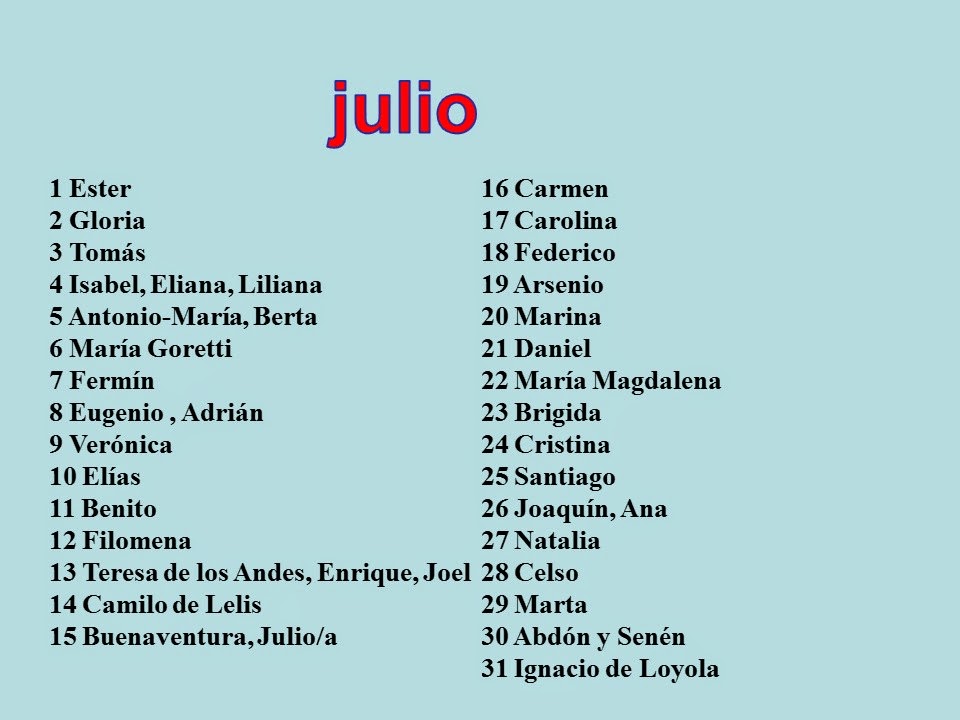
So I check the name day calendar!:-) Click here for one!
A name day is like a birthday, you celebrate it once a year, when your name comes up in the calendar. In Catholic countries, like Spain and Latin America, if your name was given after a saint, you celebrate on the day the church celebrate the saint. The tradition is more popular in some areas than others and has changed a lot over time: if you have a look at the link I copied, you will see that everybody has a designated day, religious or not... The pupils get really excited when I encourage them to find their name days and ask their parents for gifts:-)
When we practise saying the date, or our birthdays, I give these calendars out- I say the name and they have to find the date, or the other way around. It is a good reading/ pronunciation activity and can be done between partners.
Here is a list of some previous pupils and how I found a "Spanish name" for them. When there was no equivalent, I just looked for a similar one.
Happy name day to my friends/colleagues Carmen and Natalia, who are celebrating their "santo" this month!
¡Felicidades!¡Feliz Santo!
And feel free to send me flowers on my name day, I am Hungarian and have celebrated mine all my life - it is on the 19th of November!:-)
A week ago I said goodbye to my first Year 6 class I had been teaching since Year 3. It was a small group compared to the others, there were only about 22 of them and we had long, 60-minute lessons so we really got to know each other well and learnt lots of Spanish:-)!
Here I am sharing some moments of how we said goodbye.
Transition mirrors:
In the last half term we spent some time looking at what we had learnt in the previous years and wrote down what we could say about ourselves if we looked into a Spanish mirror. I encouraged the pupils to take these to secondary school and show their new teachers!
Welcome to Spanish! - letters to the new Year 3
This is an idea I saw on Twitter, but lost the tweet and don't know who to be grateful to, sorry! I asked the pupils to write a letter to the new Year 3 who never had a Spanish lesson before and tell them what Spanish would be like. They were allowed to use decorations from the art cupboard:
These will look great on the display in September!
Goodbye gifts
I am a big charity shop and carboot sales fan. I have bought lots of dictionaries and travel books this year, they were very cheap, some cost me 5p only and the most expensive one was 50p. In the last lesson I set challenges: races, best singers and games- the winners came out to pick a book prize until everybody got chosen.
I got this card from a pupil and put it up on my wall:-) Goodbye Year 6, and good luck with languages in the future, you will be great!
This week I am celebrating a birthday: my blog is half a year old!
When I started to write it in January, my goal was to show how I adapt other people's ideas, and I also wanted to share the activities that I had created and tried with my classes. The blog has had over 10000 views, which is absolutely fantastic (even if many of these views came from my mother in Hungary who likes looking at photos of her grandchildren :-).
On this occasion I am sharing some birthday activities with you.
1, The birthday song
¡Cumpleños feliz!
I play it from the Español, Español CD by Carole Nicoll (there are lots of other great songs on the CD, highly recommended!). It also has the karaoke version without the words. The song is on display on the wall in (almost) every classroom.... And here is a story for you: 5 years ago, in my very first Spanish lesson in my new job I wanted to show how well I prepare for my lessons and how much I care about the pupils. I had asked for a copy of the register with the birthdays on and noticed that a pupil celebrated her birthday on the day I started in this Year 5 class. The class teacher was in and a new student teacher came to observe this lesson as well. After introducing myself and doing a starter activity, I made the birthday girl stand up and encouraged the rest of the group to sing ¡Cumpleños feliz! to her. The pupils looked very confused and so did the birthday girl, the class teacher and the student teacher. I repeated the instructions again in English only, just in case they didn't get what I was saying the first time. Inmediately, the class teacher said to me "Miss, she doesn't celebrate birthdays". Then I looked very confused and felt awful I did something terrible right in my first lesson in my new job. I pulled myself together and taught a good lesson still, but I blamed myself for months for not finding more out about the group. After this lesson, the class teacher told me that the pupil was a Jehova's witness, and didn't celebrate birthdays (and Christmas). Well, I am still at that school, I teach Jehova's witnesses in almost every year group and learnt my lesson by now!
Another good song is the months song on the CD "Let's sing and Learn in Spanish", it is a very catchy one, the children love it. They raise their hands or jump up when they hear their birthday months.
Ear-pulling
After the song, I ask the birthday child:
¿Cuántos años tienes?
And then, I pull the child's ear as many times as corresponds to his/her age, and encourage the rest of the pupils to do the same in the playground later (after asking for permission, of course:-). While I pull the ear, we all count in Spanish! The question/answer on the slide is a great introduction to the Spanish letter "ñ",the upside down question mark, and the accent on "cuántos".
Piñata:
I don't do this all the time, because I teach over 200 children, but occasionally I take my Piñata in, and while we sing a song, the blindfolded birthday pupil(s) have to hit the Piñata I hold with the fly swats. I stick the bottom part loosely with tape and after hitting it for 3-4 minutes the bottom will come off and guess what falls on the floor...... Spanish homework sheets:-) And some sweets for the birthday people.
This year I planned to make one in Spanish club but ran out of time unfortunately.
We practised at home, and we will definitely make one next year.
Thank you for reading the blog, here is a cake for you!
I am pleased to say that The West Lancs Primary ALL Hub (previous blog post ) had its first meeting last Wednesday in Burscough.The meeting took place in my primary school's staffroom, there were about 11 and half of us, a real variety of language professionals - the Head of MFL from Burscough Priory College,2 teaching assistants who deliver French in KS1/KS2, teachers/ directors of language companies (LCF and Euroclub schools), a language adviser, a student teacher who will be an NQT from September with languages responsibility, a subject coordinator, a German teacher, the Spanish teacher from the primary school next door and we had a French teacher from the Wirral (her website: Barbara Gleave).
Here is what happened:
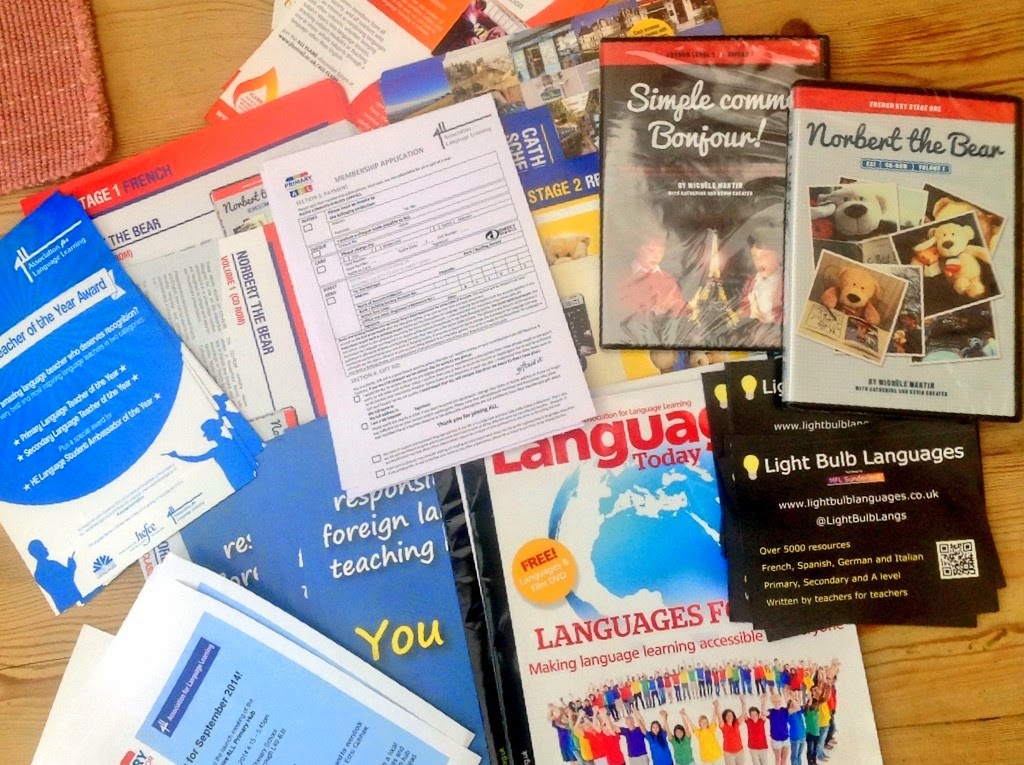
I introduced myself, I talked about the ALL and recommended that everybody should join the UK's major subject association for teachers of foreign languages (http://www.all-languages.org.uk/). I explained what a hub was and that it could take a range of formats: ours would be about networking, discussing professional issues, sharing ideas and best practice. I emphasized that I was "only a teacher" not a trainer or a consultant, and I could share classroom experience or help with Spanish upskilling. More information here: ALL primary hubs.
We all said a few words about ourselves and then...
We got right in the middle of the discussion about the new PoS (for the document click here). We also talked about schemes of work (most use our own), how long our lessons were (from 15 minutes to 60 minutes), language policies and transition to high school.
We decided that in our next meeting (in October), we will all share a resource we really like. Details to follow.
The meeting was very dynamic, there was not a moment of silence, we were all busy sharing our thoughts. I loved the dialogue, the conversation in an informal environment, and just sitting at the same table with like minded people who all made an effort to travel to Burscough in their free time.
I made goodie bags for the participants, they all had an "I love languages" certificate attached to them:
Janine, who was promoting German, gave us this book: Franzi und Felix by the Goethe Institut. Read more about this resource!
Thank you Vicky Cooke, Sue Cave and Eleanor Cobbe for your helpful emails.
And thank you, Gruffalo, for posting the hub flyers one by one in the post box! I may not have the best organising skills and expertise to run a hub, but I have you to support me:-)
Next week we are going to include some Sanfermines activities in our lessons. Here is a quick video that explains the festival:
I can't offer first hand experience like when I invited my friend Becky to talk about La Tomatina, so I persuaded my puppet teaching assistant Valentín to help me with the illustrations and borrowed my daughter's bull from her playfarm:-)
The cape - mystery voice
Instead of the blindfolds or my Spain football scarf, we will use my cape to cover the face of the volunteer who has to guess which classmate says the word/sentence in a mystery voice.
Running of the bulls - PACMAN revision game
We won't chase each other in the classroom and create complete chaos, but we can play PACMAN. 4 "toros" go in the corners of the classroom, they pretend to have bull horns with their fingers. 4 "mozos" go in between them, they put a red scarf on. The teacher or a pupil stands in the middle of the classroom and asks questions. The toros and mozos have to shout out the answers, the quickest one can move a place and "eat" the one standing next to him/her. The last one standing is the winner.
A song: Uno de enero... - dates
I use the CD/book "Preparados, Listos, Ya", I bought from Amazon, it has some good songs and there are great activities in the teacher's guide.
The same song is on YouTube:
And here is the rock version:
After the running of the bulls: at the doctor's - body parts
2 doctors race to the injured "mozo" and put a plaster on the sore body part. The slow doctor has to sit down and pick a new one. The patient volunteer says: Me duele la cabeza, el pie, la nariz, la boca, la mano, la oreja, etc.
It is interesting to hear the pupils' opinions on bullfights, and a good way to start discussions on other cultures and traditions.
You won't see a picture of me running in front of the bulls in Pamplona but a few years ago I went to Sevilla with my (now retired) puppet and signed up for a tour around the bullring to find out more about this tradition. I will definitely show some of my photos in class!
We celebrate the European Day of Languages every 26th of September in my Spanish lessons. EDL is like your wedding, you need to plan it well ahead!
3 months before the EDL:Find an eTwinning project!
Register on the eTwinning website right now, and sign up for an EDL Project. Last year, we participated in one where we had to send cards to other countries in Europe saying Happy European Day of Languages in our native languages. We made the cards in our first two Spanish lessons in September, they were 10 minute activities at the end. We received cards from all over Europe, we loved reading them and finding the countries on the Internet. Look at our display:
The "Languages take you further" book has a cartoon on each page, some useful expressions and numbers 1-10 . Order them from here! They are free but take a while to deliver, so get them now.
1 month before: Get the "I love languages" resource pack from Routes Into Languages. It includes posters, badges, certificates and calendars. The pack is not free but very reasonably priced.Currently these resources are unavailable, I have tweeted Routes Into Languages to ask about the stock, and will update the blog when there is an answer from them.
text speak badges in German, Spanish and French, can you guess what they are?
calendar in 12 different languages
"I love languages" certificates, you can write the chid's name on the back
"I love languages" badges
"I love languages" poster- we added why it's useful to learn a language
1 week before: Language challenge - A week before the big day I took the pages out of the "Languages take you further" book and made a display out of them for the classroom wall. I set a challenge: the pupils had to learn to count up to 5 in a foreign languages, learn to introduce themselves or say hello. They got a prize the following week if they said their words in class in front of everybody.
1 day before:Video about the importance of languages - Download this video from YouTube, no explanations needed:-). In class watch the clip and ask the children what happened! A very popular video, the pupils demand it all the time.
And download a popular Disney song in multilanguage version, I am sure Frozen will be a hit! Here I have my favourite, from Pocahontas:-)
On the day: Raid your kitchen cupboard and find food you can relate to the 5 most spoken languages. Show these in class and ask whether they can guess where they come from.
Mandarin Chinese: rice
English: marmite
Spanish: tortilla wraps
Hindi: Turmeric to season curries
Arabic: couscous
I know my friend Sue is planning a food tasting session , good luck to her:-)!
For more information and interesting facts, check out the BBC Languages page. If you need more ideas on how to celebrate, visit the CILT EDL webpage here.
And while I was talking about prizes so much, here is a competition: Where did I take this picture? Write your answer in the comments and I will send you a badge/sticker/ or certificate!
In April I went to Greg Horton's ALL Active Learning session, where he showed us fantastic activities for the languages classroom. I have already blogged about his tense dance before, now I will tell you about how I adapted the Mission Impossible conjugation for my primary pupils!
The new Languages Programmes of Study states that children should understand and apply high frequency verbs by the end of KS2. In Year 6 all my pupils know three singular forms of the verb "tener" (tengo, tienes, tiene), this week we added the plural forms. I made a PP with the following sentences:
Tenemos un canal. ( In Burscough there is one!)
¿Tenéis calor? ( We are in a very warm classroom in Year 6:-)
Tienen una playa. (Our penpals have one in Spain).
We have added some actions for the verbs : Tengo:we point to ourselves with one hand Tienes:we point to the one sitting next to us with one hand Tiene:we point to somebody who is sitting in the other end of the classroom with one hand
Tenemos:we point to ourselves with two hands Tenéis: we point to the ones sitting next to us with two hands Tienen: we point far away, to the other end of the classroom with two hands and think of our penpals who have a beach in Spain.
I played the "Mission Impossible" theme song and they had to walk around, do the actions and say the words. The first word (tengo) comes in the 23rd second of the video, then the rest follows with the same tune. You will understand me once you listen to the song! After the first minute I stopped the music because it changed and it was no use, and also, there was a bit of overexcitement in the classroom, and we needed to calm down. The pupils were allowed to shoot with their hands while pointing, they loved it, even in first person singular! It would work better with 4 verbs in each singular and plural, but I just let them do an extra shooting after tiene and tienen.
More Greg Horton on my friend Barbara's blog: Back to Back, a very entertaining way of "testing" the pupils.
Thank you Greg Horton, and also, thank you ALL (Association for Language Learning) for organising high quality CPD events! If you are not a member of the ALL yet, join now on their website: http://www.all-languages.org.uk/ , £36 only. Because I am an ALL member, Greg Horton's training session cost me £10 (a whole morning), and I learnt so much! What are you waiting for?:-)
.jpg)


.JPG)

.JPG)




.JPG&container=blogger&gadget=a&rewriteMime=image%2F*)


.JPG)


.JPG)